Skip to content

The best 3D scanners for 2026

A 3D scanner turns an object into a mesh that can be edited, printed or measured, and its headline figure is the least self-explanatory on this site. Accuracy is quoted in millimetres or fractions of one, and it only means something beside the conditions the maker attaches — the size of the object, the distance, and whether the figure is a single-frame or a volumetric one over a whole scan. A listing that prints the number without the condition is quoting the best case. The technology divides the shelf: structured light projects a pattern and suits small and medium objects indoors, infrared suits people and larger forms, and laser lines suit shiny or dark surfaces that other methods struggle with. The object size range is published as a minimum and a maximum, and it is the specification that decides whether a coin and a car door are both possible. Tracking is how the scanner knows where it is: geometry, texture, or small reflective markers stuck on the object, which work everywhere and take time. Then the output formats the software exports, whether processing needs a powerful computer or runs on a phone, and whether a turntable is included. We compare published accuracy and its conditions, technology, object size range, tracking method, output formats and computing requirements.
The machines compared on this page

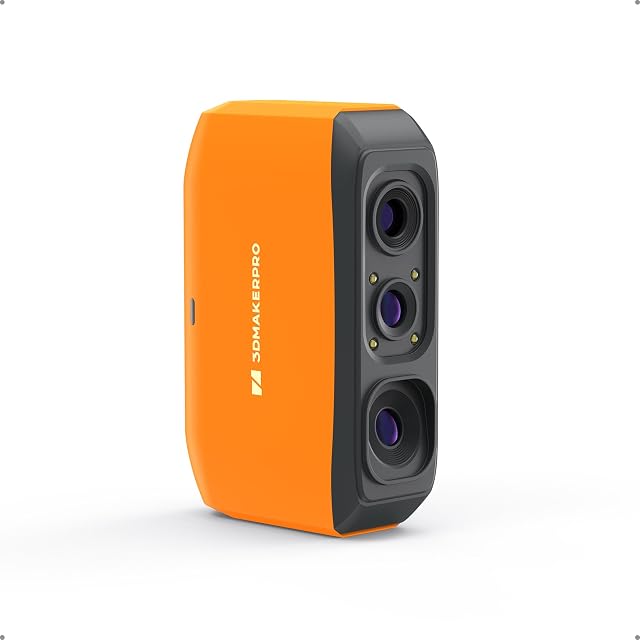
  1. 3DMakerpro Fox handheld scanner, 0.07 mm stated

    0.07 mm accuracy and 0.10 mm resolution stated, without conditions · handheld · markerless AI tracking · JMStudio software · manual turntable and power supply included

    A handheld scanner sold to 3D-printing hobbyists, whose listing states 0.07 mm accuracy and 0.10 mm resolution without saying under what conditions, and includes a manual turntable in the box.

    Best for: A 3D-printing hobbyist scanning small objects on a turntable to reproduce or modify them.

    ≈ £240 / 240 €

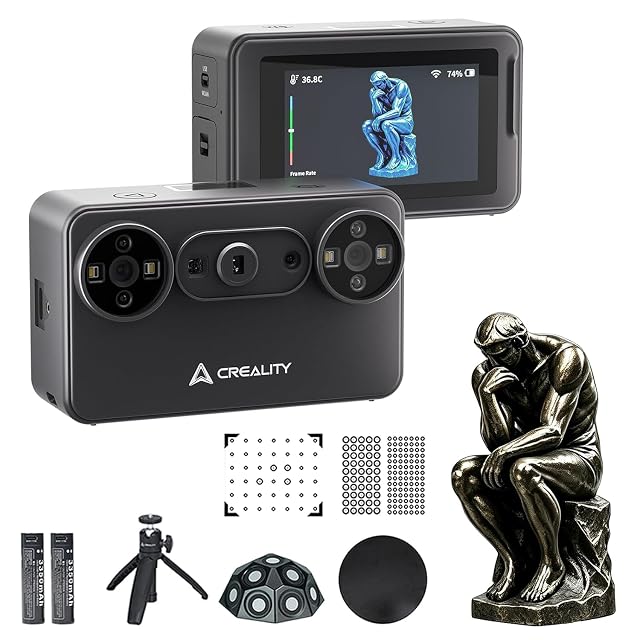
  2. Creality Pika wireless scanner, blue laser and infrared

    0.03 mm stated for blue-laser mode · 7 blue laser lines plus infrared structured light · objects 5 to 2,000 mm · Wi-Fi 6 · two 3,350 mAh batteries · STL, OBJ, PLY and ASC export

    A 260 g wireless scanner combining seven blue laser lines with infrared structured light for objects from 5 to 2,000 mm, whose listing publishes demanding phone and computer requirements alongside its 0.03 mm accuracy figure.

    Best for: A maker who already owns a recent flagship phone or a strong workstation and wants to scan objects from coin to furniture size without cables.

    ≈ 739 €

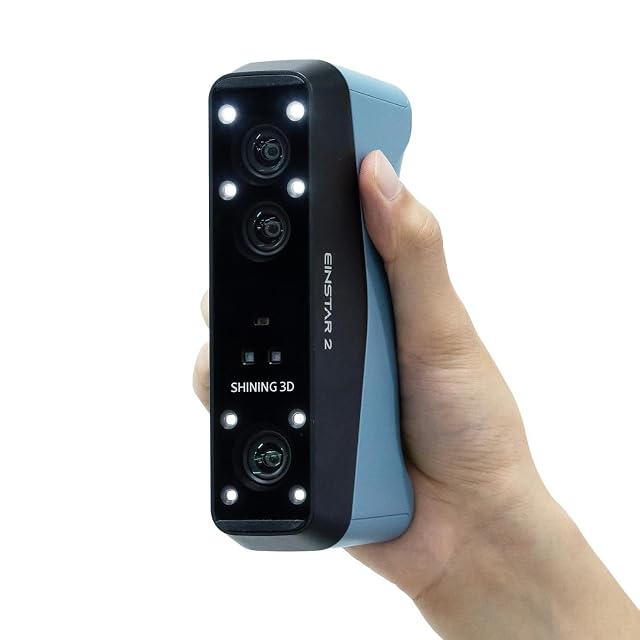
  3. EINSTAR EINSTAR 2, 17-line blue laser and VCSEL infrared

    No accuracy figure published · 17 blue laser lines and VCSEL infrared · 2,500,000 points/s stated · Wi-Fi 6 · swappable battery up to 3 h · EXStar Hub software

    The dearest scanner here, pairing a 17-line blue laser with VCSEL infrared and a swappable battery for up to three hours, whose listing publishes speeds, frame rates and lux limits but no accuracy figure at all.

    Best for: A buyer scanning reflective or dark parts in bright or changing light who can confirm accuracy and software requirements with the maker first.

    ≈ $899 / 1079 €

A price quoted in the text of a MakerVerdict page dates from the day that page was written; the live figure beside each product is fetched while you read and replaces it.