A parts list and a lesson plan, and the list is the part to read · review
noDNA We love robotics Renewable energy experiment kit, from 8 years review
A renewable energy experiment kit for children from eight, with a push-button click system for building circuits such as a solar installation and a wind turbine, and illustrated instructions in German.
The bottom line A clearly aimed children’s kit: an age, a language, a click system and a renewable energy theme. It lists no parts and no number of experiments, and it teaches electricity rather than programming.
The noDNA experiment kit listing, bullet by bullet
Ten bullets: experiments such as a solar installation and a wind turbine for children from 8; STEM learning; illustrated instructions in German; background on climate protection and sustainability; gift suggestions; a push-button click system for building circuits; STEM-focused education; a design described as child-safe; curiosity-led exploration; and many combinations for continued play.
A click system instead of a breadboard
Push-button connectors join components without tools. For an eight-year-old, that is the difference between building a circuit and waiting for an adult to wire it. It is the most concrete feature in the listing.
Electricity, not code
No microcontroller is described. The kit teaches how current flows through panels, turbines and loads — a foundation for the coding kits reviewed alongside it rather than a substitute.
Child safety in noDNA’s words
The eighth bullet describes a design focused on safety for risk-free exploration. The page reports that as the maker’s wording; the instructions and an adult decide how the kit is used.
Availability
At the last look-up, the German, French, Italian and Spanish Amazon stores were asking roughly 90 €.
The American and British Amazon catalogues list the product, yet no seller was offering it.
Every figure here is Keepa’s reading on the date this page was last updated. Stock and prices can change at any time.
Prices quoted in this text were read on 15 September 2026. The live price is at the top of the page.
Where it earns its place, and where it falls short
Strengths
A click system that assembles circuits without tools or soldering
Illustrated instructions in German, with background on climate and sustainability
Experiments built around renewable energy, such as a solar installation and a wind turbine
Compromises
No parts list, and an experiment count only on the photographed box, over 100
No programmable board: this is an electricity kit, not a coding kit
Much of the ten-bullet listing is gift copy rather than contents
Specifications
Board included
None described — circuits are built from push-button click components, sixth bullet
Itemised parts
Absent from the listing — a solar installation and a wind turbine are named among the experiments, first bullet
Tutorial format
Illustrated step-by-step instructions, third bullet
Language
German, third bullet
Soldering
None: a push-button click system connects the circuits, sixth bullet
Published age
From 8 years, title and fifth bullet
Storage
Absent from the listing
Amazon reference
B0G351BK6K (same reference on 6 Amazon marketplaces)
EAN
4251326847794
Questions makers ask before buying
How are circuits built in the noDNA kit?
The sixth bullet describes a push-button click system that lets all experiments be assembled and taken apart quickly, with no soldering.
What age is the noDNA kit for?
The title and fifth bullet say from 8 years. The eighth bullet describes a design focused on children’s safety, which the page reports as the maker’s description.
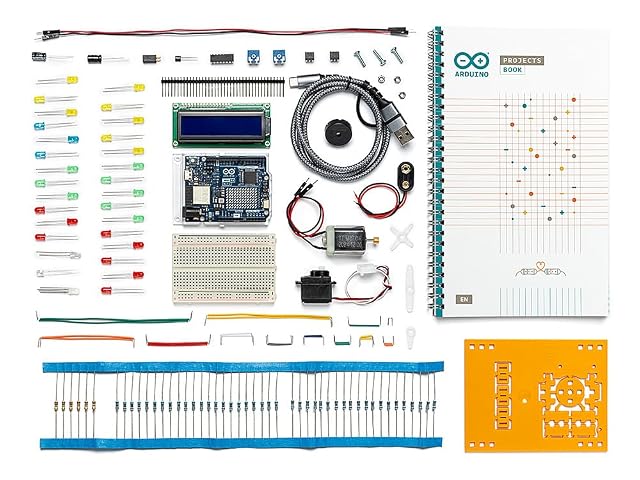
UNO R4 WiFi board · components for 13 projects · printed project book plus online repository · bonus lessons in Italian, German and French · Arduino Fundamentals certification voucher
The official Arduino Starter Kit built on the UNO R4 WiFi board, with components for 13 guided projects in a printed book, an online project repository, and a voucher for the Arduino Fundamentals certification exam.
Best for: A classroom or self-learner who wants a structured, printed course and a recognised certificate at the end.
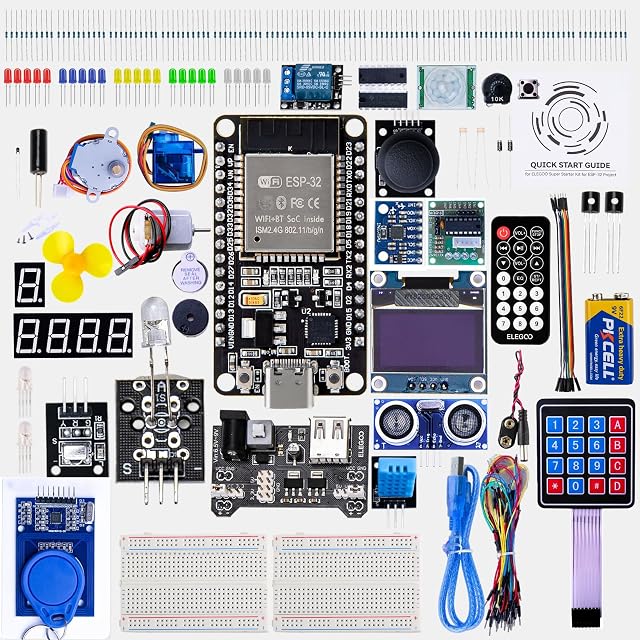
ESP-32 board, dual-core, Wi-Fi and Bluetooth 4.2 · over 35 modules and components · online tutorial, over 30 projects with code and diagrams · Arduino IDE
An ESP-32 starter kit with a dual-core board, Wi-Fi and Bluetooth 4.2, more than 35 modules including an OLED screen, servo and keypad, and an online tutorial of over 30 projects with code and wiring diagrams.
Best for: A learner moving from blinking LEDs to connected projects such as weather stations and remote controls.
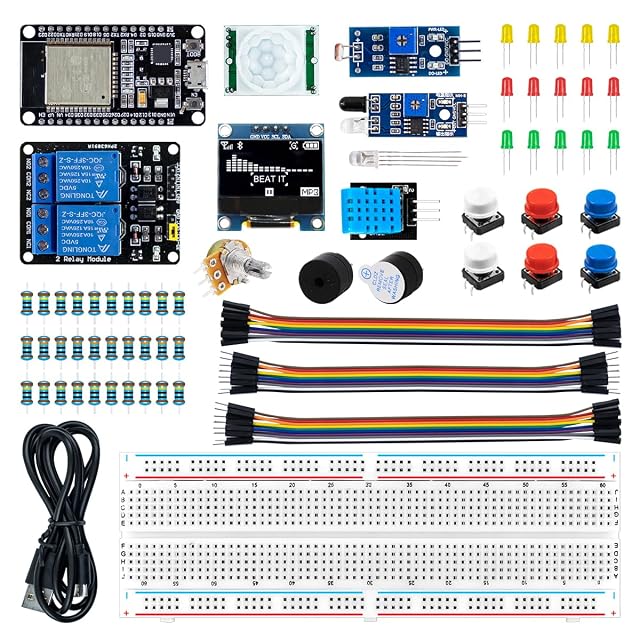
ESP32 ESP-WROOM-32 board · LED, OLED and obstacle-avoidance modules among the parts · tutorial with code and lessons · plastic storage box · Arduino IDE compatible
A beginner kit built around an ESP32 ESP-WROOM-32 board, with LEDs, an OLED module, an obstacle-avoidance module and other parts, a tutorial of lessons and code, and a plastic storage box.
Best for: A first ESP32 experiment on a budget, for someone who can follow English lessons and fill gaps online.