Logic voltage first, then pins, then the wireless it really has · review
Raspberry Pi Pico 2 W, Arm or RISC-V, Wi-Fi and Bluetooth 5.2 review
A 21 × 51 mm microcontroller board with a choice of dual Arm Cortex-M33 or dual RISC-V Hazard3 cores at 150 MHz, 26 GPIO, twelve PIO state machines, Wi-Fi and Bluetooth 5.2.
The bottom line A compact, precisely specified board: cores, memory, pin counts, radios and dimensions are all published. Logic voltage and toolchain are left out of a listing that otherwise reads like a datasheet.
The Pico 2 W listing, bullet by bullet
Six bullets: dual Arm Cortex-M33 or dual RISC-V Hazard3 processors at 150 MHz; 520 KB of on-chip SRAM and 4 MB of on-board QSPI flash; 2.4 GHz 802.11n Wi-Fi and Bluetooth 5.2; two UARTs, two SPI and two I2C controllers, 24 PWM channels, a USB 1.1 controller and PHY with host and device support, and 12 PIO state machines; 26 multi-purpose GPIO, four of them usable as ADC; and 21 × 51 mm.
Two architectures on one Raspberry Pi board
Arm or RISC-V, chosen by the user. The first bullet names both core types. For most projects the choice is invisible; for anyone learning RISC-V, it is a low-cost way in.
PIO state machines
Twelve programmable I/O blocks can generate signals — LED protocols, custom serial links — without loading the main cores. It is the feature that distinguishes this board’s pin list from the others here.
A datasheet-style listing with two gaps
Six bullets of figures and none on logic voltage or programming environment. Both have to be looked up in Raspberry Pi’s own documentation.
Availability
At the last look-up, the German, French, Italian and Spanish Amazon stores were asking 12 € to 14 €.
It is sold in the British Amazon store as well, in its own currency, which the euro figures above leave out on purpose.
The American Amazon catalogue lists the product, yet no seller was offering it.
Every figure here is Keepa’s reading on the date this page was last updated. Stock and prices can change at any time.
Prices quoted in this text were read on 15 September 2026. The live price is at the top of the page.
Where it earns its place, and where it falls short
Strengths
A choice of Arm Cortex-M33 or RISC-V Hazard3 cores on the same chip
Twelve PIO state machines for custom hardware protocols
Wi-Fi and Bluetooth 5.2 on a 21 × 51 mm board
Compromises
No logic voltage or USB connector type given
No programming environment named
Only 4 of the 26 GPIO can be used as ADC inputs
Specifications
Processor
Dual Arm Cortex-M33 or dual RISC-V Hazard3 cores at 150 MHz, first bullet
26 multi-purpose GPIO, 4 usable as ADC; 2 × UART, 2 × SPI, 2 × I2C, 24 × PWM channels, 1 × USB 1.1 controller and PHY with host and device support, 12 × PIO state machines, fourth and fifth bullets
Wireless
2.4 GHz 802.11n Wi-Fi and Bluetooth 5.2, third bullet
USB connector
Absent from the listing text as a connector — a USB 1.1 controller with host and device support is listed, and the product photograph shows a micro-USB port
Programming environment
Absent from the listing
Amazon reference
B0DNZKYGWP (same reference on 6 Amazon marketplaces)
EAN
5056561803975
Questions makers ask before buying
What does PIO mean on the Pico 2 W?
The fourth bullet lists 12 PIO state machines: programmable I/O blocks that run small programs to generate or read custom signals independently of the main cores.
Does the Pico 2 W have Bluetooth?
Yes. The third bullet lists 2.4 GHz 802.11n Wi-Fi and Bluetooth 5.2.
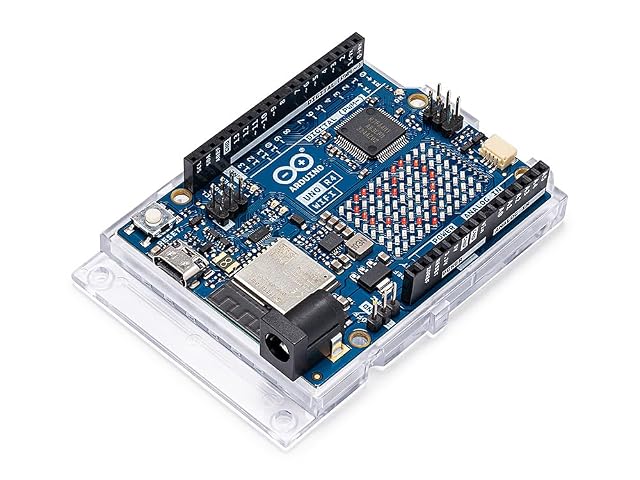
Renesas RA4M1 (Arm Cortex-M4) with ESP32-S3 · Wi-Fi and Bluetooth 5.0 · USB-C · CAN and Qwiic · 12-bit DAC and op-amp · 12 × 8 LED matrix · Arduino IDE
An Arduino UNO R4 WiFi pairing a Renesas RA4M1 Arm Cortex-M4 microcontroller with an ESP32-S3 radio chip, with USB-C, CAN, a Qwiic connector, a 12-bit DAC and a 12 × 8 LED matrix on board.
Best for: A learner or maker who wants the Arduino ecosystem with Wi-Fi, and on-board feedback from the LED matrix.
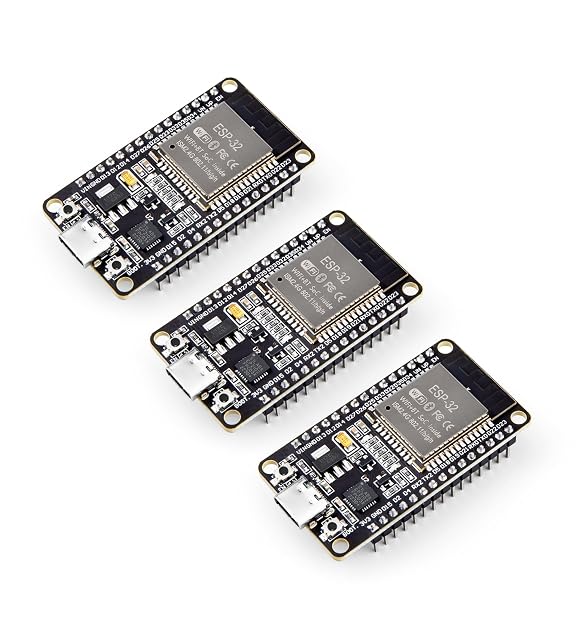
3 boards · dual-core 32-bit, up to 240 MHz · Wi-Fi 2.4 GHz and Bluetooth · GPIO, SPI, I2C · USB-C · Arduino IDE compatible · OTA firmware updates
A pack of three ESP-32 development boards with dual-core 32-bit processors up to 240 MHz, Wi-Fi and Bluetooth, USB-C and Arduino IDE compatibility, whose listing gives no memory or pin counts.
Best for: A beginner or classroom starting with ESP32 in the Arduino IDE, with spare boards for experiments.
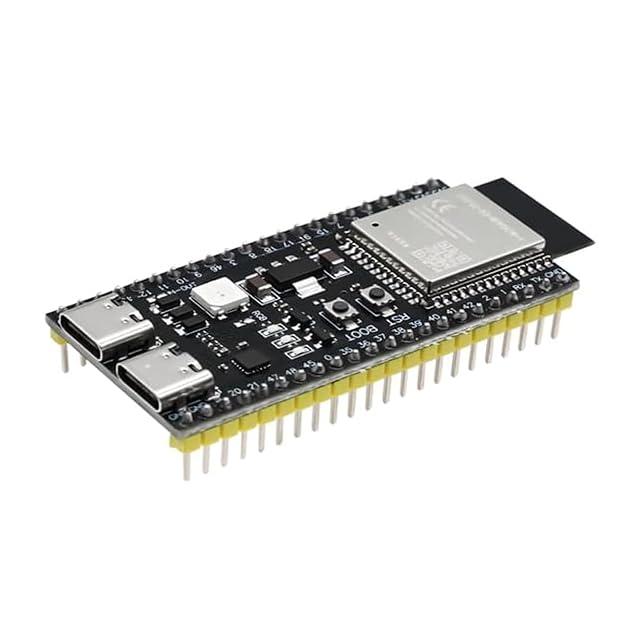
ESP32-S3, up to 240 MHz, ULP coprocessor · 512 KB SRAM, 8 M PSRAM · 45 programmable GPIO · 2.4 GHz Wi-Fi and Bluetooth 5 LE · no logic voltage, USB or IDE published
An ESP32-S3 development board on the WROOM-1-N16R8 module, with Wi-Fi, Bluetooth 5 LE, 45 programmable GPIO and external PSRAM, whose listing names neither its logic voltage, its USB connector nor a programming environment.
Best for: A maker who already works with ESP32 boards and wants an S3 with extra PSRAM at a low price.