Bandwidth and sample rate are two numbers, and neither replaces the other · review
PeakTech P 1402 benchtop, 20 MHz, 7 in screen review
A two-channel benchtop oscilloscope with 20 MHz analogue bandwidth, 250 MS/s sampling and 10,000-point memory on a 7-inch 800 × 480 screen, with FFT, XY mode, thirty automatic measurements and USBTMC.
The bottom line A benchtop scope with a large, clear screen and a generous list of measurement tools. Its 20 MHz bandwidth sits below two cheaper handhelds here, and its trigger modes and probes are not described.
The P 1402 listing, bullet by bullet
Five bullets: two channels with 20 MHz analogue bandwidth, up to 250 MS/s, 10,000 points, an 8-bit ADC, a TFT colour display and CAT II 400 V; a 7-inch 800 × 480 display with adjustable brightness; autoset, autoscale, zoom, XY, FFT, current clamp measurement, 30 automatic measurements, a frequency counter and auto cursor; USB host, USB device and USBTMC with PC software and cable; and German and English manuals with menus in German, English, French and Spanish.
A benchtop screen at a modest bandwidth
7 inches at 800 × 480 against 20 MHz. The P 1402 trades bandwidth for display and tools: FFT and thirty measurements on a large screen are easier to learn on than a small handheld, even if two of the handhelds here reach higher frequencies.
USBTMC on the PeakTech
USBTMC is the standard class for controlling test instruments over USB. With it named, the scope can be read from measurement software, not only from PeakTech’s own program.
A multimeter in the title only
The title calls it an “Oszilloskop Multimeter”, and the bullets describe no multimeter function. This review treats it as an oscilloscope with current clamp measurement, which is what the bullets support.
Availability
At the last look-up, the German, French, Italian and Spanish Amazon stores were asking 182 € to 235 €.
The American and British Amazon stores returned no entry, so the buy button there opens a search rather than a missing page.
Every figure here is Keepa’s reading on the date this page was last updated. Stock and prices can change at any time.
Prices quoted in this text were read on 15 September 2026. The live price is at the top of the page.
Where it earns its place, and where it falls short
Strengths
A 7-inch 800 × 480 screen with adjustable brightness
FFT, XY, zoom, current clamp measurement, a frequency counter and 30 automatic measurements
USB host, USB device and USBTMC, with PC software, CAT II 400 V rated and a 3-year warranty in the title
Compromises
20 MHz bandwidth on a benchtop instrument
No trigger modes or probes described
The title’s “Oszilloskop Multimeter” is not backed by any multimeter function in the bullets
Specifications
Bandwidth
20 MHz analogue bandwidth, title and first bullet
Sample rate
250 MS/s maximum, title and first bullet
Channels
2, title and first bullet
Memory depth
10,000 points, first bullet
Triggering
Absent from the listing
Decoding
Absent from the listing
Licensed features
Absent from the listing
Probes supplied
Absent from the listing text, which lists PC software and a USB cable; the product photograph shows two probes
Amazon reference
B0B4JZRFQF (same reference on 4 Amazon marketplaces)
EAN
4250569406522
Questions makers ask before buying
What input category does the PeakTech P 1402 have?
The first bullet gives CAT II 400 V.
Does the P 1402 connect to a computer?
Yes. The fourth bullet lists USB host, USB device and USBTMC, with PC software and a USB cable included.
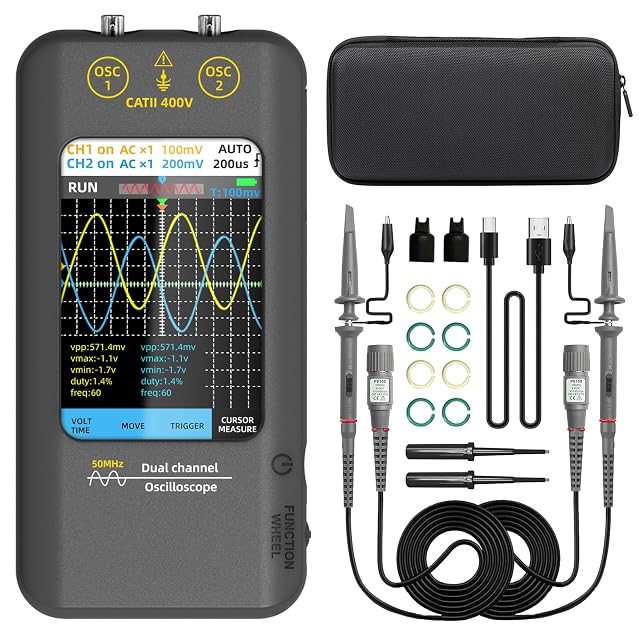
50 MHz · 250 MSa/s · 2 channels · 128K memory · resistive touchscreen, 3.98 in · DDS signal generator, 7 waveforms · 3000 mAh, over 10 h
A two-channel handheld oscilloscope with 50 MHz bandwidth, 250 MSa/s sampling and 128K memory, a 3.98-inch resistive touchscreen, a built-in seven-waveform signal generator and a 3000 mAh battery.
Best for: Car electronics and field diagnostics, where a battery-powered scope and generator in one hand is the point.
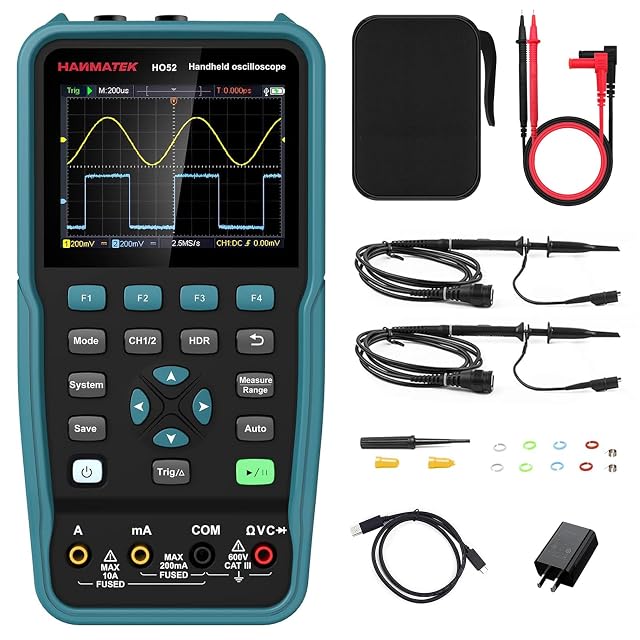
A two-channel 50 MHz handheld oscilloscope at 250 MSa/s with a 10,000 waveforms-per-second refresh, an independent 4½-digit true RMS multimeter, and a USB-C port that shows saved images and CSV waveforms as a flash drive.
Best for: Bench and field debugging where waveforms need to be saved as CSV and analysed on a computer later.
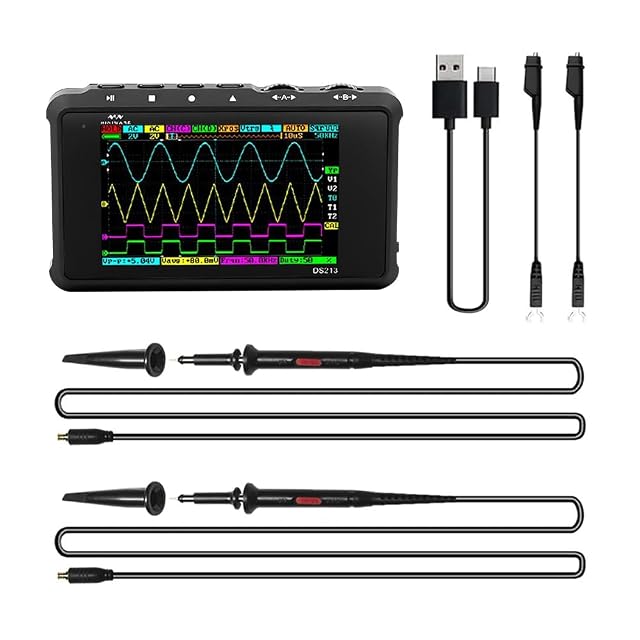
A pocket oscilloscope with two analogue and two digital channels, 15 MHz bandwidth, 100 MSa/s sampling and 4K sample depth, a 3-inch colour screen and 8 MB of storage exported over micro-USB.
Best for: A beginner learning on microcontroller and audio circuits, where digital channels matter more than bandwidth.