Bandwidth and sample rate are two numbers, and neither replaces the other · review
RIGOL DS1102Z-E, 100 MHz, 1 GSa/s, 24 Mpts review
A two-channel benchtop oscilloscope with 100 MHz bandwidth, 1 GSa/s sampling and 24 Mpts memory, protocol decoding for RS232/UART, I2C and SPI, waveform recording and playback, and USB and LAN control via SCPI.
The bottom line The strongest instrument of the five by every published figure, with decoding, deep memory and network control. The listing omits triggering and probes, and leaves open whether its decoding is licensed.
The DS1102Z-E listing, bullet by bullet
Six bullets: 100 MHz, 1 GSa/s and 24 Mpts for long captures; a frequency counter, RS232/UART, I2C and SPI decoding, FFT and automatic measurements; waveform recording and playback; a 7-inch TFT with 256 intensity levels for a phosphor-like display; USB and LAN, SCPI, and integration with LabVIEW, Visual Basic and Visual C++; and a three-year warranty for the DS1000Z-E series, with field testing, debugging and embedded design as uses.
24 Mpts at 1 GSa/s
Deep memory keeps the sample rate high over a long window. 24 million points at 1 GSa/s hold 24 milliseconds at full rate — enough to capture a whole serial exchange with its edges intact, which a short record cannot do without slowing the sampling.
Decoding, and the licence question
Seeing I2C addresses and UART bytes on screen, rather than counting bits, is the reason an embedded developer buys this instrument. The listing lists the protocols and does not say whether they are enabled out of the box, which is worth confirming.
Intensity grading on the RIGOL screen
256 intensity levels show how often a trace passes a point, like the glow of an analogue phosphor screen. Rare glitches appear faint rather than invisible, which helps find them.
Availability
At the last look-up, the German, French, Italian and Spanish Amazon stores were asking 284 € to 388 €.
It is sold in the British Amazon store as well, in its own currency, which the euro figures above leave out on purpose.
The American Amazon store returned no entry, so the buy button there opens a search rather than a missing page.
Every figure here is Keepa’s reading on the date this page was last updated. Stock and prices can change at any time.
Prices quoted in this text were read on 15 September 2026. The live price is at the top of the page.
Where it earns its place, and where it falls short
Strengths
100 MHz, 1 GSa/s and 24 Mpts, the highest figures of the five oscilloscopes here
Protocol decoding for RS232/UART, I2C and SPI, and waveform recording with playback
USB and LAN with SCPI, for control from LabVIEW, Visual Basic and Visual C++
Compromises
No trigger modes described
Probes appear in the photograph but are not listed in the text
The listing does not say whether decoding is standard or licensed
Specifications
Bandwidth
100 MHz, title and first bullet
Sample rate
1 GSa/s, title and first bullet
Channels
2, title
Memory depth
24 Mpts, first bullet
Triggering
Absent from the listing
Decoding
RS232/UART, I2C and SPI protocol decoding, second bullet
Licensed features
Absent from the listing — whether decoding requires a licence is not stated
Probes supplied
Absent from the listing text — the product photograph shows two probes
Amazon reference
B089WHC4MK (same reference on 5 Amazon marketplaces)
EAN
6973332403624
Questions makers ask before buying
Which protocols can the RIGOL DS1102Z-E decode?
The second bullet lists RS232/UART, I2C and SPI. The listing does not say whether decoding is included as standard or requires a licence.
Can the DS1102Z-E be controlled remotely?
The fifth bullet says it has USB and LAN interfaces for PC remote control, supports SCPI and integrates with LabVIEW, Visual Basic and Visual C++.
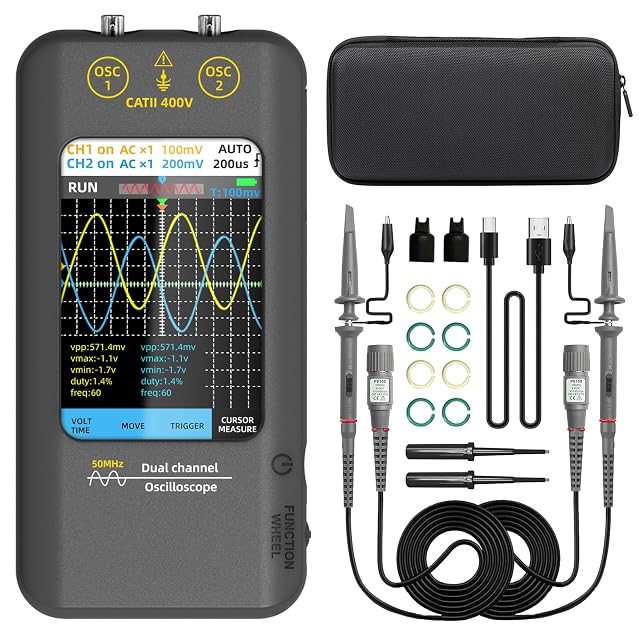
50 MHz · 250 MSa/s · 2 channels · 128K memory · resistive touchscreen, 3.98 in · DDS signal generator, 7 waveforms · 3000 mAh, over 10 h
A two-channel handheld oscilloscope with 50 MHz bandwidth, 250 MSa/s sampling and 128K memory, a 3.98-inch resistive touchscreen, a built-in seven-waveform signal generator and a 3000 mAh battery.
Best for: Car electronics and field diagnostics, where a battery-powered scope and generator in one hand is the point.
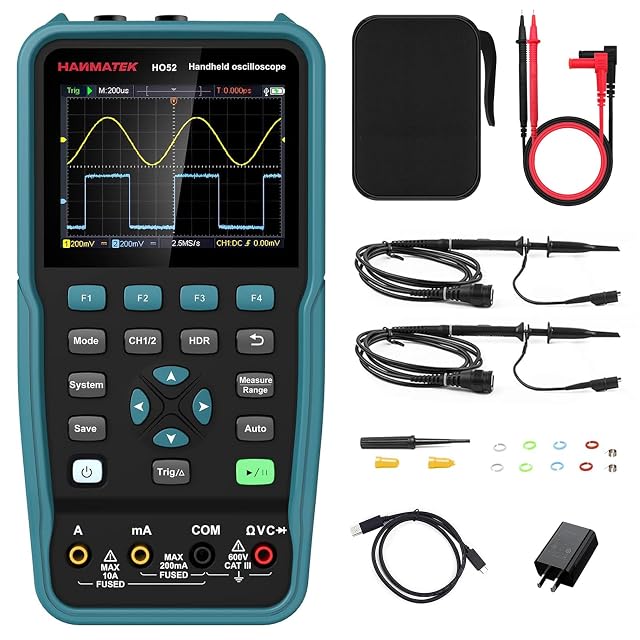
A two-channel 50 MHz handheld oscilloscope at 250 MSa/s with a 10,000 waveforms-per-second refresh, an independent 4½-digit true RMS multimeter, and a USB-C port that shows saved images and CSV waveforms as a flash drive.
Best for: Bench and field debugging where waveforms need to be saved as CSV and analysed on a computer later.
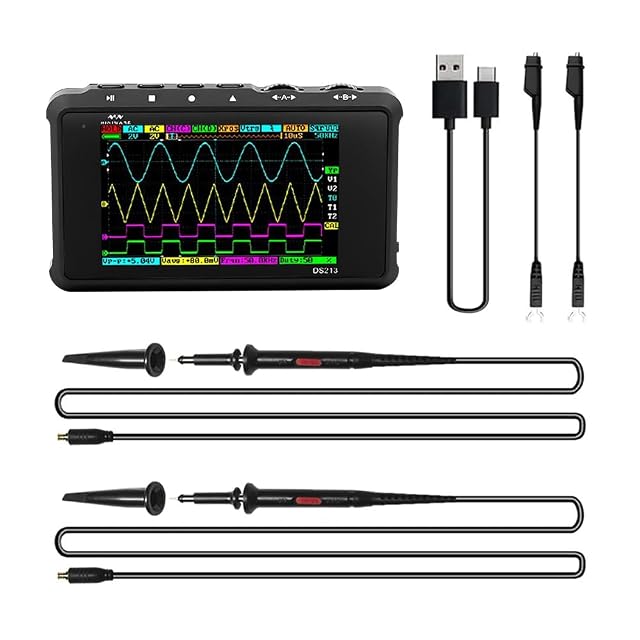
A pocket oscilloscope with two analogue and two digital channels, 15 MHz bandwidth, 100 MSa/s sampling and 4K sample depth, a 3-inch colour screen and 8 MB of storage exported over micro-USB.
Best for: A beginner learning on microcontroller and audio circuits, where digital channels matter more than bandwidth.