A single-board computer on the hexa-core Amlogic A311D with a 5.0 TOPS neural processing unit, 4 GB of memory and 32 GB of storage, switchable PCIe or USB 3.0, Gigabit Ethernet with wake-on-LAN and two MIPI-CSI camera inputs.
The bottom line The most capable board of the four, with a neural processor, two camera inputs and switchable PCIe. The listing calls it both Pro and Basic, and it says nothing about the power, cooling and operating system such a board depends on.
The Khadas VIM3 listing, bullet by bullet
Six bullets: an Amlogic A311D with four Cortex-A73 cores at 2.2 GHz and two Cortex-A53 cores at 1.8 GHz on a 12 nm process; an NPU supporting TensorFlow and Caffe at 5.0 TOPS INT8; a stackable design, a programmable MCU, programmable LEDs, SPI flash and Khadas TST and KBI; dual independent displays, H.264 and H.265 encoding and 4K decoding for signage and kiosks; MIPI-CSI for two cameras, a real-time clock, wake-on-LAN and a three-axis G-sensor; and two Wi-Fi antennas with professional and open-source support.
Pro in the title, Basic in the text
The title reads VIM3 Pro (4+32GB); three bullets say VIM3 Basic. Two names suggest two versions, and the listing does not describe the difference. The title’s 4 GB and 32 GB are the figures this review uses, and the version is worth confirming.
An NPU on a single-board computer
5.0 TOPS of neural inference is what separates the VIM3 from the Raspberry Pi 4 boards here. It runs trained models — object detection, classification — on dedicated hardware rather than on the processor cores.
What the Khadas page leaves out
Power input is mentioned without a figure, and neither cooling nor operating system is described. For a board sold for AI and signage work, those are the questions to settle first.
Availability
At the last look-up, the German, French, Italian and Spanish Amazon stores were asking roughly 209 €.
It is sold in the British Amazon store as well, in its own currency, which the euro figures above leave out on purpose.
The American Amazon store returned no entry, so the buy button there opens a search rather than a missing page.
Every figure here is Keepa’s reading on the date this page was last updated. Stock and prices can change at any time.
Prices quoted in this text were read on 15 September 2026. The live price is at the top of the page.
Where it earns its place, and where it falls short
Strengths
A hexa-core A311D with a 5.0 TOPS NPU supporting TensorFlow and Caffe
Switchable PCIe or USB 3.0, Gigabit Ethernet with wake-on-LAN, and two camera inputs
A programmable MCU, programmable LEDs, a real-time clock, a G-sensor and two Wi-Fi antennas included
Compromises
The title says VIM3 Pro; three bullets say VIM3 Basic
No operating system, power requirement or cooling described
No GPIO header described
Specifications
Processor
Amlogic A311D, four Cortex-A73 cores at 2.2 GHz and two Cortex-A53 cores at 1.8 GHz, 12 nm; NPU with 5.0 TOPS INT8 inference, first and second bullets
RAM
4 GB, title (“4+32GB”)
Storage options
32 GB, title; 16 MB SPI flash, title and third bullet
GPIO header
Absent from the listing text — a stackable design and a programmable MCU are described, third bullet, and the product photograph shows a 40-pin header
Ports
PCIe and USB 3.0 switchable, Gigabit Ethernet with WOL and Bluetooth 5.0, title; MIPI-CSI for two cameras and dual independent displays, fourth and fifth bullets
Power requirement
Absent from the listing
Cooling
Absent from the listing
Operating system support
Absent from the listing — TensorFlow and Caffe are named for the NPU, second bullet
Amazon reference
B082SBR5HL (same reference on 5 Amazon marketplaces)
EAN
0724873165498
Questions makers ask before buying
Is the Khadas board a VIM3 Pro or a VIM3 Basic?
The title says VIM3 Pro with 4 GB and 32 GB; the second, fourth and fifth bullets refer to the VIM3 Basic motherboard. The listing does not explain the difference, so the version should be confirmed.
What does the VIM3 NPU support?
The second bullet says the neural processing unit supports common deep learning frameworks such as TensorFlow and Caffe, with 5.0 TOPS INT8 inference.
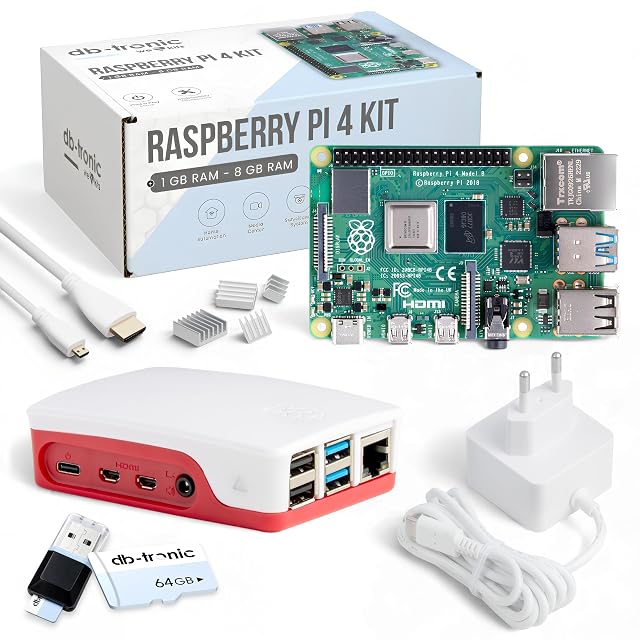
Raspberry Pi 4, 1 GB in the title and 4 GB in the part number · 15 W supply · official case · 64 GB card and USB reader · 4-piece aluminium heatsinks · 1 m 4K micro-HDMI cable
A Raspberry Pi 4 starter set with a 15 W power supply, a case, a 64 GB memory card with USB reader, four aluminium heatsinks and a micro-HDMI cable, whose title says 1 GB and whose part number says 4 GB.
Best for: A first Raspberry Pi for a light Home Assistant or retro gaming setup, once the memory size has been confirmed.
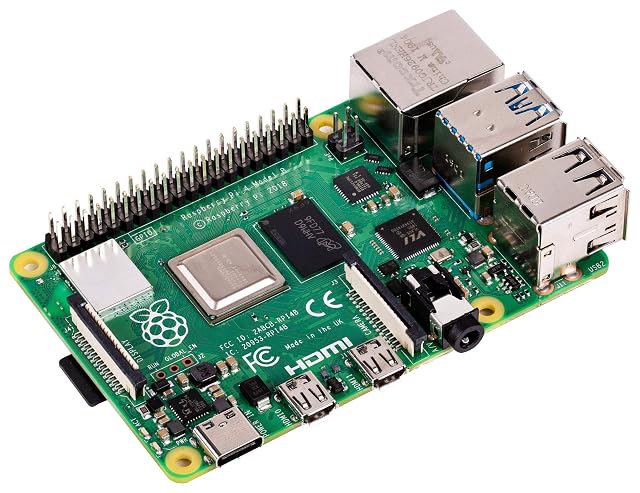
Broadcom BCM2711, quad Cortex-A72 64-bit at 1.5 GHz · 2 GB · 40-pin GPIO · 2 × USB 3.0, 2 × USB 2.0, Gigabit Ethernet · dual-band Wi-Fi, Bluetooth 5.0 · no power, storage or cooling details
The Raspberry Pi 4 Model B with 2 GB, built on a Broadcom BCM2711 quad-core Cortex-A72 at 1.5 GHz, with two USB 3.0 and two USB 2.0 ports, Gigabit Ethernet, dual-band Wi-Fi and the standard 40-pin header.
Best for: A maker who already has a power supply, a microSD card and a case, and wants the bare board.
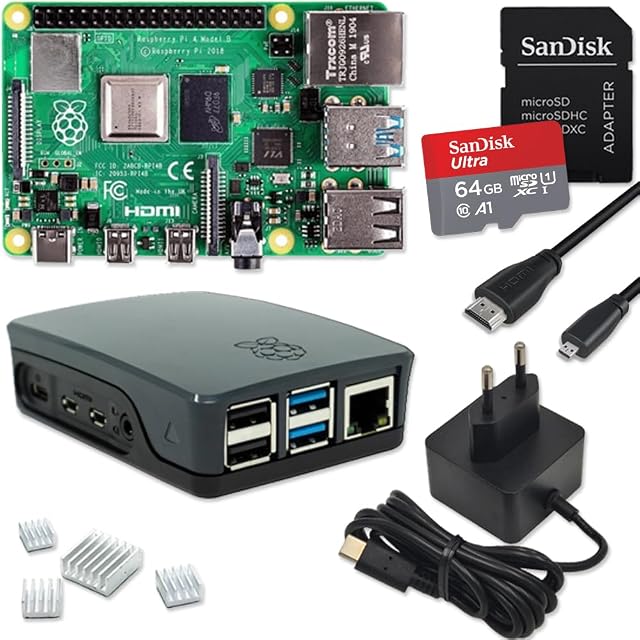
Raspberry Pi 4 with 4 GB · 15 W USB-C supply · official case, black · Ultra 64 GB microSDHC with SD adapter · 4-piece aluminium heatsinks · 1 m 4K micro-HDMI cable
A Raspberry Pi 4 starter set with 4 GB of memory, a 15 W USB-C supply, a black case, a 64 GB microSDHC card with adapter, aluminium heatsinks and a 4K micro-HDMI cable.
Best for: A Home Assistant or retro gaming setup that benefits from 4 GB, bought as one box.