The frame and the motion system decide more than the speed on the box · review
AnkerMake M5 with AI failure detection review
A printer whose 500 mm/s maximum depends on a firmware, slicer and app update, with 7 × 7 auto-levelling and a camera that pauses a failed print, and a listing that gives no build volume.
The bottom line The listing is more candid than most about its headline speed, attaching the update it depends on, and it publishes a real levelling grid and a failure-detection behaviour. It leaves out the build volume entirely, and the price gap between Germany and the rest of Europe is large enough to check at the moment of ordering.
The AnkerMake M5 listing, bullet by bullet
Six bullets: 500 mm/s with PowerBoost 2.0, raising power output by 30 % over the previous version to double speed and acceleration once the slicer, firmware and app are updated; 0.1 mm precision from a new direct extruder and an integrated die-cast aluminium structure; smart failure detection with a built-in camera that pauses prints on detachment, spaghetti or clogs; the die-cast aluminium structure and Z-axis design lowering the centre of gravity; remote control from the app, the slicer or Alexa; and 7 × 7 automatic levelling with a virtual height map.
A speed claim with its condition attached
The 500 mm/s depends on an update. The listing says so in the same bullet, which is more than most. The figure remains what every published speed on this site is: the limit of the motion system in a fast mode, not the rate at which parts leave the bed.
0.1 mm, read as a claim
The title and the second bullet print 0.1 mm precision. No method, axis or part is named. This page keeps it as the maker’s wording and does not treat it as the accuracy of a finished object, which depends on material, calibration and design.
What the camera does
The third bullet describes a camera and a print plan used to compare progress with the model, pausing the job and notifying the owner on detachment, spaghetti or jams. It is a monitoring feature, and the listing describes it as saving time and material rather than as a guarantee.
Availability
At the last look-up, the German Amazon store was asking roughly 236 €.
It is sold in the British Amazon store as well, in its own currency, which the euro figures above leave out on purpose.
Asking prices on the French, Italian and Spanish Amazon stores ran past 1.6× the lowest country’s. A gap that size points to goods shipped in from abroad rather than a local seller, so those offers are left out of the figures above.
The American Amazon store returned no entry, so the buy button there opens a search rather than a missing page.
Every figure here is Keepa’s reading on the date this page was last updated. Stock and prices can change at any time.
Prices quoted in this text were read on 15 September 2026. The live price is at the top of the page.
Where it earns its place, and where it falls short
Strengths
Says plainly that the 500 mm/s figure requires updating the slicer, firmware and app, which most speed claims leave out
A camera that watches the print and pauses it on detachment, spaghetti or clogs, as the third bullet describes
7 × 7 automatic levelling with a height map, a published grid size rather than only the word automatic
Compromises
No build volume, no temperatures and no bed surface published
The title’s 0.1 mm precision is a claim without the conditions that would define it, and it is not a part tolerance
The German price at the time of reading was far below the other European stores, which ran from 499 € to 821 €
Specifications
Build volume
Absent from the listing — six bullets and the title contain no dimension
Motion system
Absent from the listing as a kinematic type; the fourth bullet describes an integrated die-cast aluminium structure and Z-axis design that lower the centre of gravity
Levelling method
7 × 7 automatic levelling that builds a virtual height map, sixth bullet
Hotend
Absent from the listing; the second bullet describes a new direct extruder
Bed temperatures
Absent from the listing
Bed surface
Absent from the listing
Enclosure
Absent from the listing — no enclosure is mentioned
Published speed
500 mm/s in fast mode, stated as reached with PowerBoost 2.0 after updating the AnkerMake slicer, firmware and app; a motion maximum, not a print rate
Amazon reference
B0B78K165Y (same reference on 5 Amazon marketplaces)
EAN
0194644106935
Questions makers ask before buying
Is the 500 mm/s available out of the box?
The first bullet says PowerBoost 2.0 doubles speed and acceleration once the AnkerMake slicer, firmware and app are updated to the latest version. It describes a maximum of the motion system in fast mode, not the speed at which a clean part is printed.
What does 0.1 mm precision mean here?
It is the figure the maker prints in the title and second bullet, without stating how or on what it was measured. This page reports it as the maker’s claim; it is not a tolerance measured on a finished part.
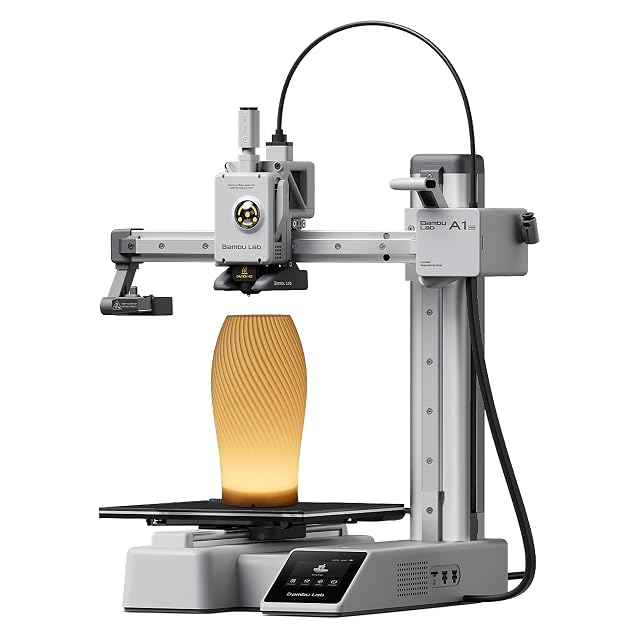
No build volume published · fully automatic calibration · eddy-current nozzle pressure sensor · LED lamp set included · MakerWorld and Bambu Handy app
A compact printer bundled with an LED lamp kit, whose listing describes an eddy-current sensor that measures nozzle pressure and fully automatic calibration, and publishes neither a build volume nor a speed.
Best for: A beginner who wants a printer that calibrates itself and a ready-made first project, and who is content to work inside the maker’s app and library.
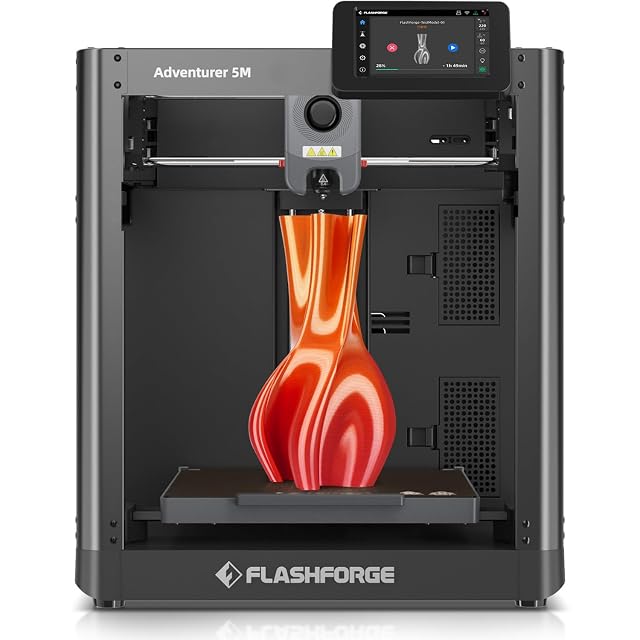
220 × 220 × 220 mm build volume · all-metal CoreXY · one-click automatic levelling · 3-second quick-change nozzles 0.25 to 0.8 mm · double-sided PEI plate · 600 mm/s maximum
A CoreXY printer with a 220 mm cube build volume, tool-free nozzles in four diameters that change in three seconds, and a double-sided PEI plate whose back is meant for PETG.
Best for: Someone printing everyday PLA and PETG parts who wants a published 220 mm volume and the option of a fine or a fast nozzle.
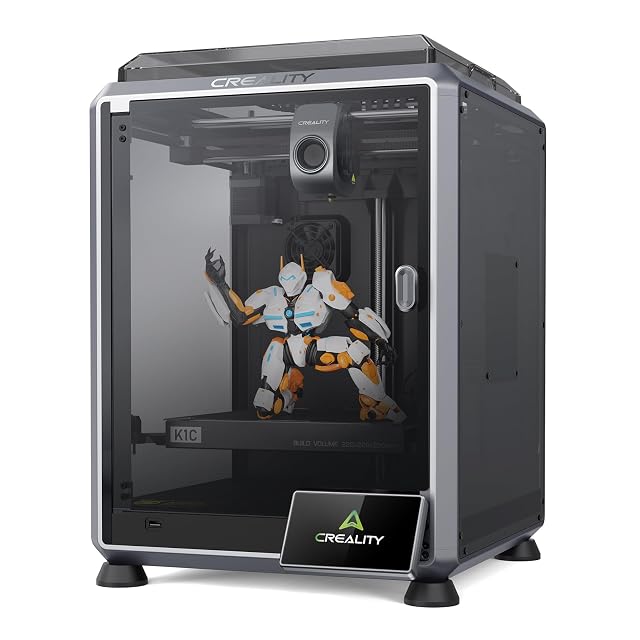
No build volume published · enclosed · CoreXY at 600 mm/s and 20,000 mm/s² maximum · direct drive · 300 °C hotend with hardened steel nozzle · auto-levelling and Z-offset
The dearest of the seven FDM printers here, an enclosed CoreXY with a 300 °C hotend and hardened steel nozzle for carbon-fibre filaments, whose listing publishes acceleration and temperature but no build volume.
Best for: A maker moving to carbon-filled and engineering filaments who wants an enclosed printer with a hardened nozzle already fitted.