The frame and the motion system decide more than the speed on the box · review
Flashforge Adventurer 5M, 220 mm CoreXY review
A CoreXY printer with a 220 mm cube build volume, tool-free nozzles in four diameters that change in three seconds, and a double-sided PEI plate whose back is meant for PETG.
The bottom line One of the most completely described printers in this family: volume, kinematics, levelling method, nozzle range and plate surface are all on the page. The trade-off is the proprietary nozzle, which is convenient to change and only available from one source.
The Adventurer 5M listing, bullet by bullet
Six bullets: a printer for beginners and experienced users alike; fully automatic one-click levelling that measures the gap between nozzle and plate; an all-metal CoreXY motion structure for quiet high-speed printing; a patented quick-change nozzle in 0.25, 0.4, 0.6 and 0.8 mm, replaced in 3 seconds without tools; the Orca-Flashforge slicer with one-click batch file transfer and network monitoring of several printers, plus the Flash Maker app; and power-loss recovery, with a flexible double-sided PEI steel plate whose back is designed for PETG.
Four nozzles, one standard
The nozzle system is the detail that follows the owner. Changing from 0.4 to 0.8 mm for fast, strong parts or to 0.25 mm for detail takes seconds, and the listing publishes all four sizes. Each of them belongs to the maker’s patented design, which means spares and hardened versions come from that range rather than from the wide market of standard nozzles.
The PETG side of the plate
Smooth PEI can bond to PETG strongly enough to damage the surface. A plate with a side intended for PETG is the maker’s answer, and it is one of the few listings here that addresses a specific filament on a specific surface.
Gaps in the Flashforge listing
No bed or nozzle temperature and no enclosure. For ABS or ASA, which need a warm, still environment, the page offers nothing to plan with.
Availability
At the last look-up, the German, French, Italian and Spanish Amazon stores were asking roughly 249 €.
The American and British Amazon catalogues list the product, yet no seller was offering it.
Every figure here is Keepa’s reading on the date this page was last updated. Stock and prices can change at any time.
Prices quoted in this text were read on 15 September 2026. The live price is at the top of the page.
Where it earns its place, and where it falls short
Strengths
Publishes the build volume in all three dimensions and names the motion system
Four nozzle diameters from 0.25 to 0.8 mm that change without tools, useful for trading detail against speed
A plate with a dedicated PETG side, which addresses PETG bonding too strongly to smooth PEI
Compromises
The nozzles are a patented quick-change design, so replacements come from the maker’s own range
No bed or nozzle temperatures published, which leaves engineering filaments unaddressed
Absent from the US and UK stores at the time of reading
Specifications
Build volume
220 × 220 × 220 mm, stated in the title
Motion system
All-metal CoreXY motion structure, third bullet
Levelling method
Fully automatic one-click levelling that measures the nozzle-to-plate distance and sets the offset, second bullet
Hotend
Patented quick-change nozzle, replaced without tools in 3 seconds, available in 0.25, 0.4, 0.6 and 0.8 mm; no maximum temperature published
Bed temperatures
Absent from the listing
Bed surface
Flexible double-sided PEI steel plate, removed by bending; the back side is designed for PETG, sixth bullet
Enclosure
Absent from the listing — no enclosure is mentioned
Published speed
Up to 600 mm/s, title; a motion maximum
Amazon reference
B0DMNJ57RG (same reference on 6 Amazon marketplaces)
EAN
6937120321262
Questions makers ask before buying
Can standard nozzles be fitted?
The listing describes a patented quick-change nozzle system in four diameters. It does not mention compatibility with other nozzle standards, so the maker’s range is the one to plan around.
Does it resume after a power cut?
The sixth bullet says the current layer is saved during a power outage and printing resumes from that point once power returns.
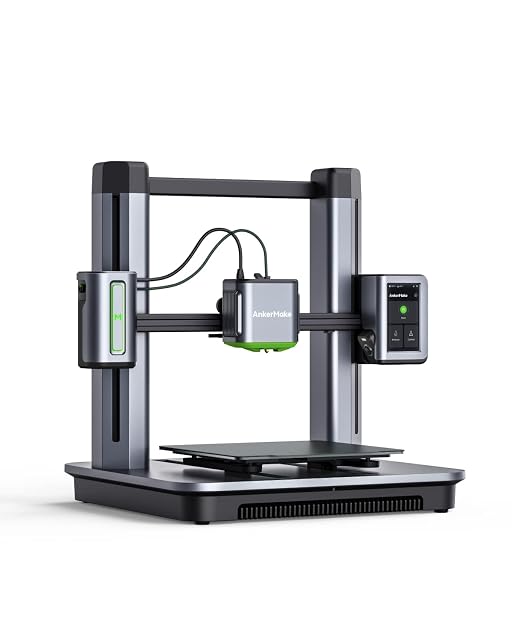
No build volume published · 500 mm/s after PowerBoost 2.0 update · 7 × 7 auto-levelling · direct extruder · camera with failure detection · die-cast aluminium frame
A printer whose 500 mm/s maximum depends on a firmware, slicer and app update, with 7 × 7 auto-levelling and a camera that pauses a failed print, and a listing that gives no build volume.
Best for: A buyer who prints long jobs unattended and values a camera that stops a failed print more than a published build volume.
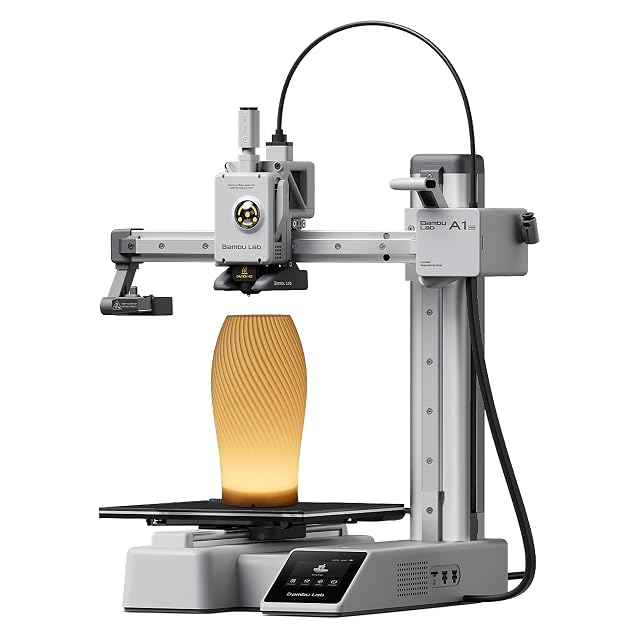
No build volume published · fully automatic calibration · eddy-current nozzle pressure sensor · LED lamp set included · MakerWorld and Bambu Handy app
A compact printer bundled with an LED lamp kit, whose listing describes an eddy-current sensor that measures nozzle pressure and fully automatic calibration, and publishes neither a build volume nor a speed.
Best for: A beginner who wants a printer that calibrates itself and a ready-made first project, and who is content to work inside the maker’s app and library.
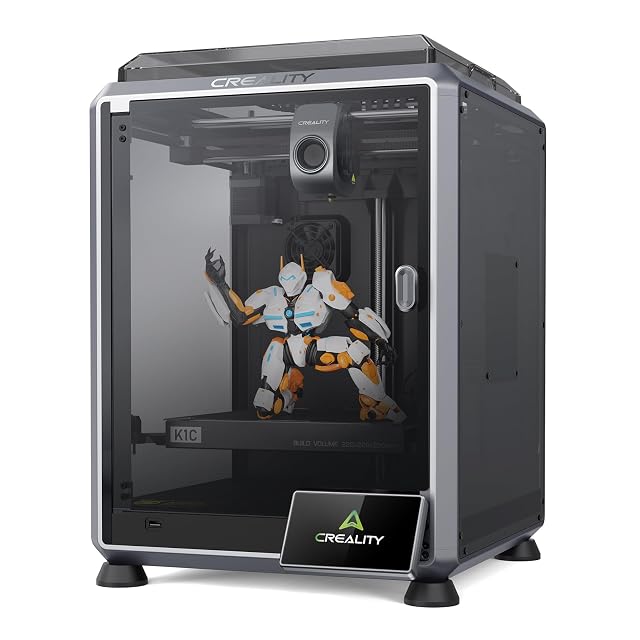
No build volume published · enclosed · CoreXY at 600 mm/s and 20,000 mm/s² maximum · direct drive · 300 °C hotend with hardened steel nozzle · auto-levelling and Z-offset
The dearest of the seven FDM printers here, an enclosed CoreXY with a 300 °C hotend and hardened steel nozzle for carbon-fibre filaments, whose listing publishes acceleration and temperature but no build volume.
Best for: A maker moving to carbon-filled and engineering filaments who wants an enclosed printer with a hardened nozzle already fitted.