The frame and the motion system decide more than the speed on the box · review
Creality K1C 2025, enclosed CoreXY with AI camera review
The dearest of the seven FDM printers here, an enclosed CoreXY with a 300 °C hotend and hardened steel nozzle for carbon-fibre filaments, whose listing publishes acceleration and temperature but no build volume.
The bottom line The listing is strong on the parts that make engineering filaments possible — temperature, hardened nozzle, enclosure — and publishes acceleration as well as speed. Its silence on build volume means the one figure every buyer checks first has to come from the maker’s documentation.
The K1C 2025 listing, bullet by bullet
Five bullets: 600 mm/s CoreXY with 20,000 mm/s² acceleration, a direct-drive extruder and a tri-metal Unicorn nozzle; ready to use out of the box, with automatic levelling and Z-offset calibration; an AI camera for real-time monitoring, failure detection such as spaghetti and time-lapse recording; carbon-fibre and engineering filaments enabled by the enclosed build space, the 300 °C hotend and the hardened steel nozzle; and an optimised cooling system.
Built around harder materials
This is the only FDM listing in the family that joins enclosure, temperature and nozzle hardness in one sentence. Carbon-filled filaments wear brass quickly, ABS and ASA warp in open air, and PA-CF needs heat. The listing addresses all three and names the filaments.
Acceleration beside speed
The first bullet gives 20,000 mm/s² as well as 600 mm/s. Both describe what the motion system can do; neither is a print time. Acceleration is the more informative of the two for small, detailed parts, where a printer rarely reaches its top speed.
The figure to find elsewhere
No build volume is published on this page. Creality’s own documentation for the K1C is the place to confirm it before deciding whether large parts fit.
Availability
At the last look-up, the German, French, Italian and Spanish Amazon stores were asking 449 € to 479 €.
The American and British Amazon stores returned no entry, so the buy button there opens a search rather than a missing page.
Every figure here is Keepa’s reading on the date this page was last updated. Stock and prices can change at any time.
Prices quoted in this text were read on 15 September 2026. The live price is at the top of the page.
Where it earns its place, and where it falls short
Strengths
Publishes the hotend temperature, 300 °C, and names the carbon-fibre filaments it is meant for: PLA-CF, PETG-CF and PA-CF
A hardened steel nozzle for abrasive filaments, which cheaper printers here leave to a later purchase
Enclosed, pre-assembled, and fitted with a camera for spaghetti detection and time-lapses
Compromises
No build volume published, the first figure this family is compared on
No bed temperature and no bed surface, despite naming ABS and ASA
Absent from the US and UK stores at the time of reading
Specifications
Build volume
Absent from the listing — the title and five bullets name no dimension
Motion system
CoreXY with up to 600 mm/s and 20,000 mm/s² acceleration, first bullet
Levelling method
Automatic levelling and Z-offset calibration, second bullet
Hotend
300 °C hotend with a direct-drive extruder, a tri-metal Unicorn nozzle and a hardened steel nozzle, first and fourth bullets
Bed temperatures
Absent from the listing
Bed surface
Absent from the listing
Enclosure
Enclosed build space, fourth bullet
Published speed
600 mm/s with 20,000 mm/s² acceleration; motion maximums
Amazon reference
B0CWTYDNR9 (same reference on 4 Amazon marketplaces)
EAN
0198549008202
Questions makers ask before buying
Which filaments does the listing name?
The fourth bullet names PLA, PETG, TPU, ABS and ASA, and carbon-fibre filaments PLA-CF, PETG-CF and PA-CF, citing the enclosed build space, the 300 °C hotend and the hardened steel nozzle.
What does the AI camera do?
It monitors the print in real time and supports detection of typical failures such as spaghetti, according to the third bullet, and it records time-lapses.
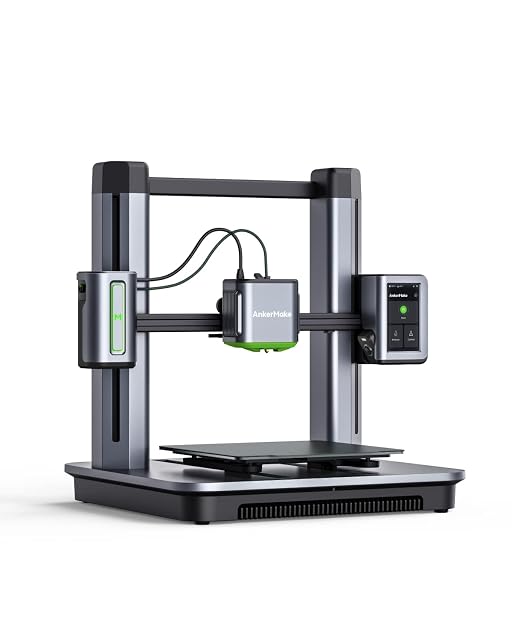
No build volume published · 500 mm/s after PowerBoost 2.0 update · 7 × 7 auto-levelling · direct extruder · camera with failure detection · die-cast aluminium frame
A printer whose 500 mm/s maximum depends on a firmware, slicer and app update, with 7 × 7 auto-levelling and a camera that pauses a failed print, and a listing that gives no build volume.
Best for: A buyer who prints long jobs unattended and values a camera that stops a failed print more than a published build volume.
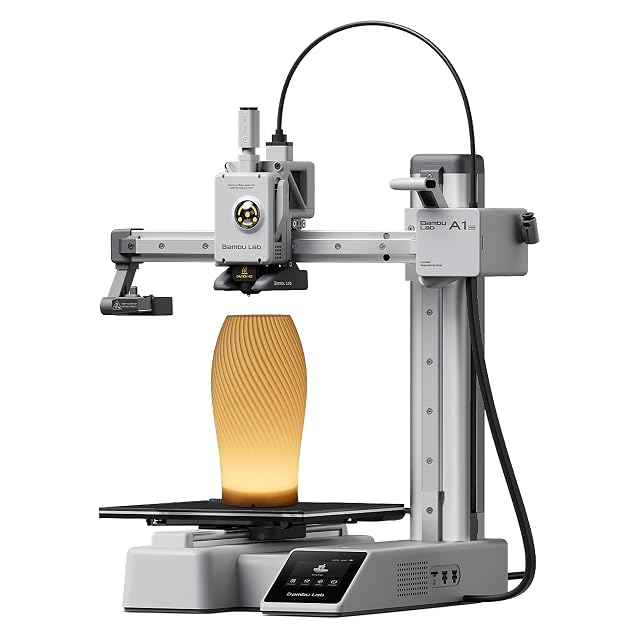
No build volume published · fully automatic calibration · eddy-current nozzle pressure sensor · LED lamp set included · MakerWorld and Bambu Handy app
A compact printer bundled with an LED lamp kit, whose listing describes an eddy-current sensor that measures nozzle pressure and fully automatic calibration, and publishes neither a build volume nor a speed.
Best for: A beginner who wants a printer that calibrates itself and a ready-made first project, and who is content to work inside the maker’s app and library.
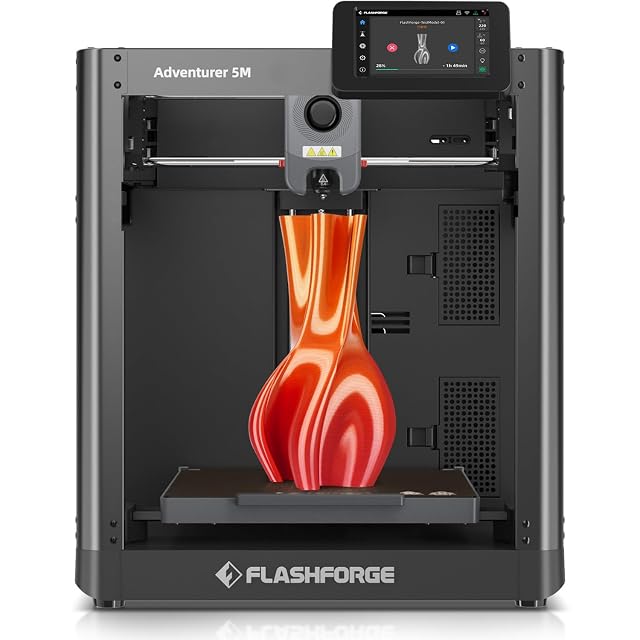
220 × 220 × 220 mm build volume · all-metal CoreXY · one-click automatic levelling · 3-second quick-change nozzles 0.25 to 0.8 mm · double-sided PEI plate · 600 mm/s maximum
A CoreXY printer with a 220 mm cube build volume, tool-free nozzles in four diameters that change in three seconds, and a double-sided PEI plate whose back is meant for PETG.
Best for: Someone printing everyday PLA and PETG parts who wants a published 220 mm volume and the option of a fine or a fast nozzle.