The frame and the motion system decide more than the speed on the box · review
Bambu Lab A1 Mini with LED lamp kit review
A compact printer bundled with an LED lamp kit, whose listing describes an eddy-current sensor that measures nozzle pressure and fully automatic calibration, and publishes neither a build volume nor a speed.
The bottom line The listing sells an experience — calibration done for you, a library, an app, a lamp to print — and describes one real mechanism behind it. What it does not do is publish the size, speed or temperatures that would let it be compared with the rest of this family on paper.
The A1 Mini listing, bullet by bullet
Five bullets: the A1 Mini with an LED lamp set for printing compatible lamp housings; an ideal first printer with fully automatic calibration, easy setup and a compact footprint; print quality from a high-frequency eddy-current sensor that measures nozzle pressure while an algorithm compensates flow; the Bambu Lab ecosystem of the MakerWorld model library and the Bambu Handy app; and a printer described as fast, quiet and reliable.
One mechanism, described properly
The nozzle pressure sensor is the most specific sentence on the page. Most listings in this family claim quality; this one names how it is pursued. The page reports it as the maker’s description, without a measured effect, because none is published.
The figures that are not there
No build volume, no motion system, no bed or nozzle temperature and no speed. A compact printer can still have a useful volume, but this page cannot state it: a number remembered from elsewhere is not a number published on this listing.
Working inside an ecosystem
The fourth bullet describes the maker’s library and app as the way to find models and control prints. The listing does not describe third-party slicers or offline use, and a buyer who wants either should look for the maker’s own documentation before relying on it.
Availability
At the last look-up, the German, French and Italian Amazon stores were asking roughly 219 €.
It is sold in the American and British Amazon stores as well, in their own currency, which the euro figures above leave out on purpose.
The Spanish Amazon catalogue lists the product, yet no seller was offering it.
Every figure here is Keepa’s reading on the date this page was last updated. Stock and prices can change at any time.
Prices quoted in this text were read on 15 September 2026. The live price is at the top of the page.
Where it earns its place, and where it falls short
Strengths
Describes a concrete mechanism for flow control, an eddy-current sensor measuring nozzle pressure, rather than only a quality claim
Fully automatic calibration and a setup time of 20 minutes stated in the title
Bundled LED lamp set for printing working lamps, which gives a first project out of the box
Compromises
No build volume, no speed and no temperatures on the page
The ecosystem described — MakerWorld, Bambu Handy app — is the maker’s own, and the listing does not say what works without it
Absent from the Spanish store at the time of reading
Specifications
Build volume
Absent from the listing — the second bullet calls it compact enough for any desk, and no dimension is given
Motion system
Absent from the listing
Levelling method
Fully automatic calibration, second bullet
Hotend
Absent from the listing as a specification; the third bullet describes a high-frequency eddy-current sensor measuring pressure in the nozzle, with flow compensation by the maker’s algorithm
Bed temperatures
Absent from the listing
Bed surface
Absent from the listing
Enclosure
Absent from the listing — no enclosure is mentioned
Published speed
Absent from the listing — the fifth bullet says fast and quiet, with no figure
Amazon reference
B0GQMJ8QQT (same reference on 6 Amazon marketplaces)
EAN
6937285514110
Questions makers ask before buying
What is the LED lamp set for?
The first bullet says it is included so that compatible lamp housings can be printed and turned into working decorative lights. It is a bundle item, not a feature of the printer.
What does the eddy-current sensor do?
According to the third bullet it measures pressure in the nozzle at high frequency, and the maker’s algorithm compensates the flow rate. The listing presents it as a quality feature; it publishes no figure for its effect.
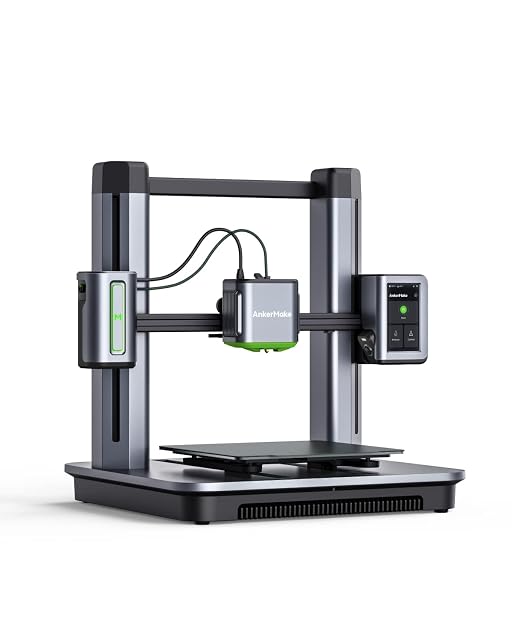
No build volume published · 500 mm/s after PowerBoost 2.0 update · 7 × 7 auto-levelling · direct extruder · camera with failure detection · die-cast aluminium frame
A printer whose 500 mm/s maximum depends on a firmware, slicer and app update, with 7 × 7 auto-levelling and a camera that pauses a failed print, and a listing that gives no build volume.
Best for: A buyer who prints long jobs unattended and values a camera that stops a failed print more than a published build volume.
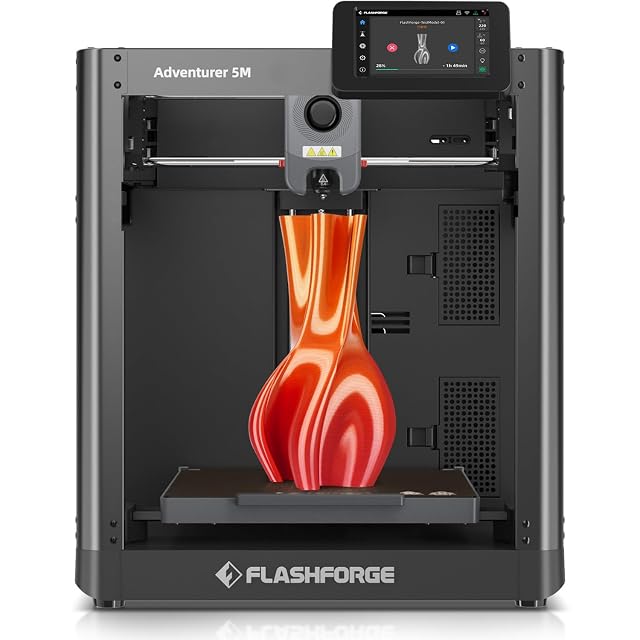
220 × 220 × 220 mm build volume · all-metal CoreXY · one-click automatic levelling · 3-second quick-change nozzles 0.25 to 0.8 mm · double-sided PEI plate · 600 mm/s maximum
A CoreXY printer with a 220 mm cube build volume, tool-free nozzles in four diameters that change in three seconds, and a double-sided PEI plate whose back is meant for PETG.
Best for: Someone printing everyday PLA and PETG parts who wants a published 220 mm volume and the option of a fine or a fast nozzle.
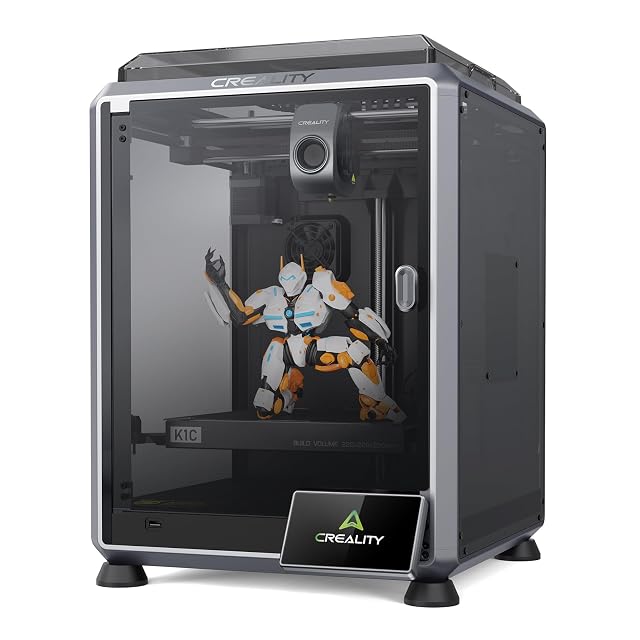
No build volume published · enclosed · CoreXY at 600 mm/s and 20,000 mm/s² maximum · direct drive · 300 °C hotend with hardened steel nozzle · auto-levelling and Z-offset
The dearest of the seven FDM printers here, an enclosed CoreXY with a 300 °C hotend and hardened steel nozzle for carbon-fibre filaments, whose listing publishes acceleration and temperature but no build volume.
Best for: A maker moving to carbon-filled and engineering filaments who wants an enclosed printer with a hardened nozzle already fitted.