The frame and the motion system decide more than the speed on the box · review
Malyan M320 Mini, 150 mm cube build volume review
The cheapest printer in this family, sold for children and beginners, whose listing publishes a 150 mm cube build volume, an all-metal hotend and a removable magnetic plate, and no print speed at all.
The bottom line A small, simply described printer whose listing is honest about its size — 150 mm in every direction — and silent about speed, temperatures and enclosure. At the bottom of this family’s price range it is a starting machine, and the page reads that way.
The Malyan M320 listing, bullet by bullet
Five numbered bullets: a 150 × 150 × 150 mm print size with a heated bed and a wide range of extruder temperatures for most 1.75 mm filaments; a touchscreen interface used to level the bed and pick a part; a single extruder printing PLA, ABS, wood, copper, steel and bronze fills, with a microSD card of preinstalled models; an all-metal hotend with a heat-break design, a stable metal base and a side-mounted filament holder; and a removable magnetic build plate with a flexible sheet, automatic calibration with a WLAN connection, and printing over USB or from a card.
What a 150 mm cube means on this shelf
It is a declared size, and it is small. The two other FDM printers here that publish a volume declare 220 mm and 270 mm across the plate. A 150 mm cube holds figurines, keyrings and small functional parts; it does not hold a helmet or an enclosure panel. Parts larger than the volume can be split in the slicer and printed in sections.
The levelling contradiction
The second bullet describes navigating the touchscreen to level the bed. The fifth mentions automatic calibration with a WLAN connection. A buyer should read the manual before assuming either: the listing states both and explains neither.
What the Malyan listing leaves out
No print speed, no bed or nozzle temperature and no enclosure. For a child’s first machine the missing enclosure is the line that matters most, because the nozzle and bed are hot and exposed; the maker’s instructions are the place to read how the printer should be supervised.
Availability
At the last look-up, the German, French, Italian and Spanish Amazon stores were asking 150 € to 220 €.
It is sold in the British Amazon store as well, in its own currency, which the euro figures above leave out on purpose.
The American Amazon store returned no entry, so the buy button there opens a search rather than a missing page.
Every figure here is Keepa’s reading on the date this page was last updated. Stock and prices can change at any time.
Prices quoted in this text were read on 15 September 2026. The live price is at the top of the page.
Where it earns its place, and where it falls short
Strengths
Publishes all three build dimensions, 150 mm each, which four dearer printers in this family do not
Prints from a microSD card with preloaded models or over USB from a Windows or Mac computer, so no account or app is required
An all-metal hotend at this price, which the maker describes as resistant to wear
Compromises
Two bullets describe levelling in two different ways, touchscreen navigation and automatic calibration, without saying which applies
No print speed and no temperature figures for the bed or the hotend
The build volume is the smallest of the three FDM printers here that publish one
Specifications
Build volume
150 × 150 × 150 mm, stated in the title and again in the first bullet
Motion system
Absent from the listing — no kinematics are named; the fourth bullet mentions only a stable metal base
Levelling method
The second bullet says the bed is levelled by navigating the touchscreen; the fifth mentions automatic calibration with a WLAN connection. The two statements are not reconciled on the page
Hotend
All-metal hotend with a heat-break design, fourth bullet. No maximum temperature is given, only a wide range of extruder temperatures
Bed temperatures
Absent from the listing — the bed is described as heated, with no temperature figure
Bed surface
Removable magnetic build plate with a flexible magnetic print sheet
Enclosure
Absent from the listing — no enclosure is mentioned, and the photographs show an open frame
Published speed
Absent from the listing
Amazon reference
B07W54L5KX (same reference on 5 Amazon marketplaces)
EAN
6415495775359
Questions makers ask before buying
Which materials does the listing say it prints?
The third bullet names PLA, ABS, wood fill, copper fill, steel fill and bronze fill, among others, in 1.75 mm diameter. Filled filaments are abrasive on brass nozzles; the listing does not say what the nozzle is made of, only that the hotend is all-metal.
Does it need to be connected to a computer?
No. The fifth bullet says it prints from 3D model files stored on a microSD card without any PC connection, and alternatively over USB from a Windows or Mac computer.
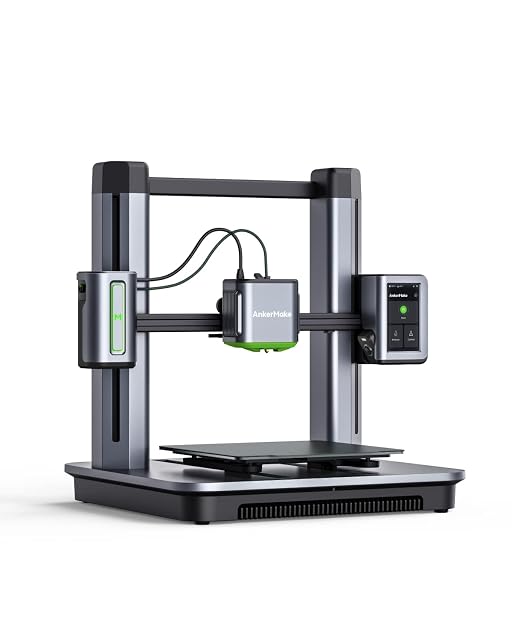
No build volume published · 500 mm/s after PowerBoost 2.0 update · 7 × 7 auto-levelling · direct extruder · camera with failure detection · die-cast aluminium frame
A printer whose 500 mm/s maximum depends on a firmware, slicer and app update, with 7 × 7 auto-levelling and a camera that pauses a failed print, and a listing that gives no build volume.
Best for: A buyer who prints long jobs unattended and values a camera that stops a failed print more than a published build volume.
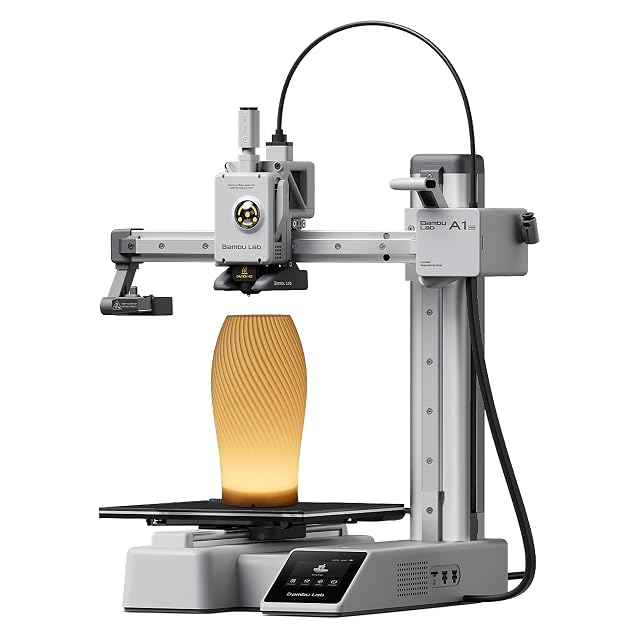
No build volume published · fully automatic calibration · eddy-current nozzle pressure sensor · LED lamp set included · MakerWorld and Bambu Handy app
A compact printer bundled with an LED lamp kit, whose listing describes an eddy-current sensor that measures nozzle pressure and fully automatic calibration, and publishes neither a build volume nor a speed.
Best for: A beginner who wants a printer that calibrates itself and a ready-made first project, and who is content to work inside the maker’s app and library.
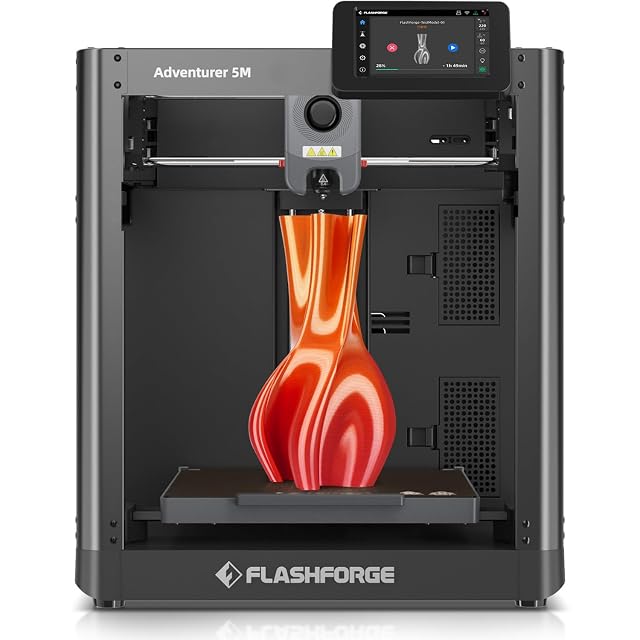
220 × 220 × 220 mm build volume · all-metal CoreXY · one-click automatic levelling · 3-second quick-change nozzles 0.25 to 0.8 mm · double-sided PEI plate · 600 mm/s maximum
A CoreXY printer with a 220 mm cube build volume, tool-free nozzles in four diameters that change in three seconds, and a double-sided PEI plate whose back is meant for PETG.
Best for: Someone printing everyday PLA and PETG parts who wants a published 220 mm volume and the option of a fine or a fast nozzle.