The frame and the motion system decide more than the speed on the box · review
SainSmart PrintyGo Mini, enclosed printer for children review
A pre-assembled, fully enclosed printer sold as a STEM toy for children aged 8 and up, whose door stops the print when opened, and whose listing never states how large a part it can make.
The bottom line The listing is written for parents, and on its own terms it answers their questions: enclosed, door interlock, no computer needed, a large model library. It does not answer the printer questions — how big, how hot, what surface — and a buyer comparing machines has nothing to weigh.
The PrintyGo listing, bullet by bullet
Five bullets: why PrintyGo, combining a child-proof design, 600 mm/s printing and easy setup in a compact printer; child-proof and environmentally friendly, with a fully enclosed housing and a safety lock that stops the print when the door opens, and a statement that it is made of non-toxic PLA; easy use for children and parents, working without a smartphone or computer and without complicated slicing, yet compatible with Cura; designed for children from 8 as a STEM learning toy; and a library of over 1,500 3D models updated weekly.
A children’s printer described by its door
The enclosure is the specification this page can confirm. A fully closed housing and a door interlock are published provisions, and for a machine meant for a child they matter more than any speed figure. This page reports them as the maker describes them and does not rate the printer as safe; supervision and the maker’s instructions decide how it is used.
The missing dimensions
No build volume, no hotend, no bed temperature and no bed surface are published. The title calls the printer mini, which describes the outside rather than what it can make. The practical consequence is that nobody can say from this page whether a given school project fits.
The 600 mm/s headline
The figure appears twice. It describes the motion system’s maximum; a child printing a PLA figure will not see parts finished at that rate, and the listing does not publish typical print times.
Availability
At the last look-up, the German, French, Italian and Spanish Amazon stores were asking 180 € to 185 €.
It is sold in the American and British Amazon stores as well, in their own currency, which the euro figures above leave out on purpose.
Every figure here is Keepa’s reading on the date this page was last updated. Stock and prices can change at any time.
Prices quoted in this text were read on 15 September 2026. The live price is at the top of the page.
Where it earns its place, and where it falls short
Strengths
An enclosure with a door interlock that stops printing when opened, described in its own bullet
Works out of the box without a phone or computer, and also accepts Cura for users who want a full slicer
A library of more than 1,500 models that the maker says is updated weekly
Compromises
No build volume anywhere on the page, the first figure this family is compared on
No hotend, bed or temperature information, so the materials it can print are not stated beyond PLA
A 600 mm/s headline on a children’s printer describes motion, and the listing does not say what print times to expect
Specifications
Build volume
Absent from the listing — the title calls it compact and mini, and no dimension appears in any bullet
Motion system
Absent from the listing
Levelling method
Auto-levelling, stated in the title
Hotend
Absent from the listing
Bed temperatures
Absent from the listing
Bed surface
Absent from the listing
Enclosure
Fully enclosed housing that keeps hands away from moving and hot parts, with a lock that stops the print as soon as the door is opened, second bullet
Published speed
600 mm/s, given in the title and the first bullet; a maximum of the motion system, not a rate at which parts are finished
Amazon reference
B0FQ5GR74Y (same reference on 6 Amazon marketplaces)
EAN
0810168145105
Questions makers ask before buying
What does the listing mean by child-proof?
It describes two provisions: a fully enclosed housing that prevents contact with moving or hot parts, and a lock that stops the print when the door opens. This page reports those provisions as the maker describes them; the maker’s instructions say how a child should use the machine.
Does it need slicing software?
The third bullet says complicated slicing is not needed and the printer works straight out of the box; it also says Cura is supported for advanced users.
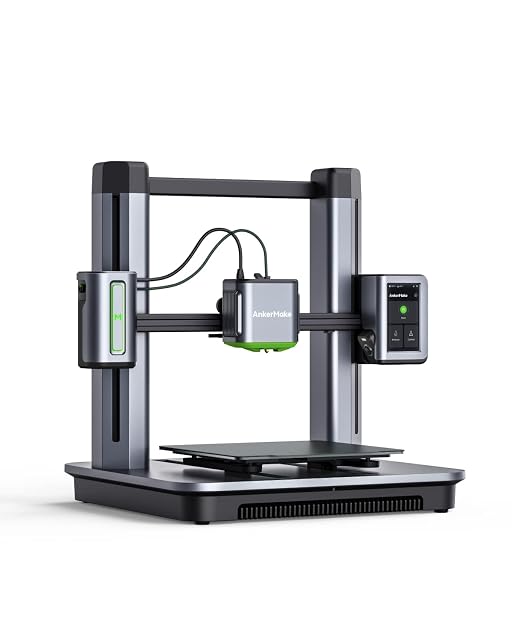
No build volume published · 500 mm/s after PowerBoost 2.0 update · 7 × 7 auto-levelling · direct extruder · camera with failure detection · die-cast aluminium frame
A printer whose 500 mm/s maximum depends on a firmware, slicer and app update, with 7 × 7 auto-levelling and a camera that pauses a failed print, and a listing that gives no build volume.
Best for: A buyer who prints long jobs unattended and values a camera that stops a failed print more than a published build volume.
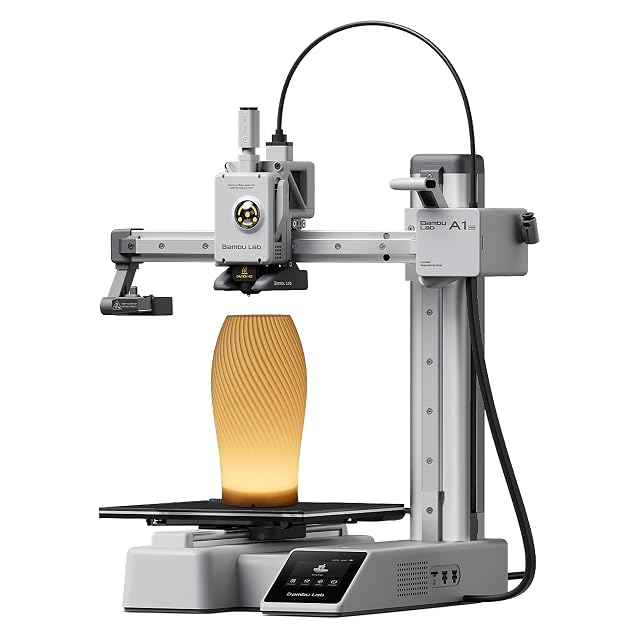
No build volume published · fully automatic calibration · eddy-current nozzle pressure sensor · LED lamp set included · MakerWorld and Bambu Handy app
A compact printer bundled with an LED lamp kit, whose listing describes an eddy-current sensor that measures nozzle pressure and fully automatic calibration, and publishes neither a build volume nor a speed.
Best for: A beginner who wants a printer that calibrates itself and a ready-made first project, and who is content to work inside the maker’s app and library.
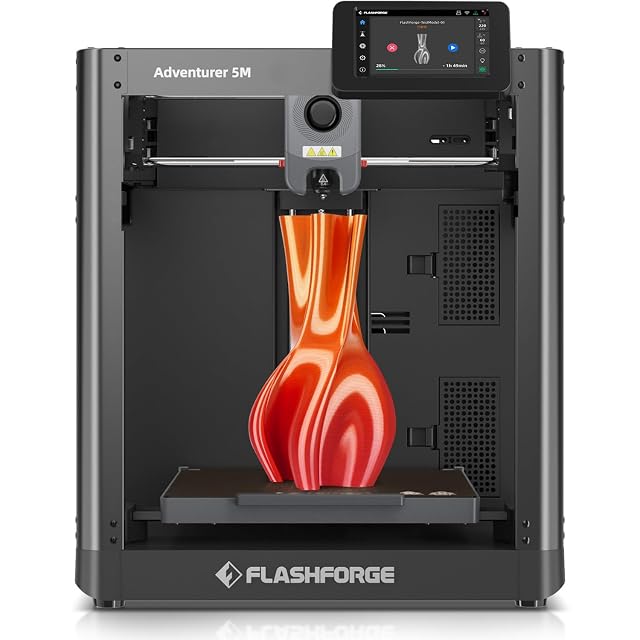
220 × 220 × 220 mm build volume · all-metal CoreXY · one-click automatic levelling · 3-second quick-change nozzles 0.25 to 0.8 mm · double-sided PEI plate · 600 mm/s maximum
A CoreXY printer with a 220 mm cube build volume, tool-free nozzles in four diameters that change in three seconds, and a double-sided PEI plate whose back is meant for PETG.
Best for: Someone printing everyday PLA and PETG parts who wants a published 220 mm volume and the option of a fine or a fast nozzle.